


Few objects in the history of design can be said to have changed the way we look at a room. The Tulip collection by Eero Saarinen is one of them. Designed in the late 1950s for Knoll International, this family of single-pedestal chairs and tables overturned the conventions of contemporary furniture and continues to define the aesthetic of the most discerning interiors.
At UBER-MODERN, authorised Knoll dealer in Paris, we guide clients through this collection every day. Here is its story, and the reasons it does not age.
Eero Saarinen and the Problem of the Slum of Legs
Born in Finland in 1910 and emigrated to the United States at the age of 13, Eero Saarinen grew up in one of the most stimulating households in American architecture. Trained as an architect at Yale, he developed early a vision that few designers of his generation shared: the interior space must be conceived as an organic whole, without break between floor, furniture and ceiling.
This conviction led him to articulate what he called the problem of the slum of legs: under every ordinary table, a forest of chair legs, rungs and stretchers that visually fragment the space and undermine the coherence of the whole.
I want to clear up the slum of legs in the modern world. This confused world needs the serenity of unity and calm.


Five Years of Research for a Single Pedestal


Saarinen worked on this project for more than five years, from 1952, in the Knoll workshops. The initial ambition was total: to create a chair in one piece, one material, on a single pedestal. An object with no visible seam, as natural as a flower on its stem.
The technical reality of the time imposed a compromise. Saarinen opted for a two-material solution: a reinforced fibreglass shell, organic and light, resting on a cast aluminium pedestal, denser and stronger. Both are lacquered the same colour to create the illusion of a monolithic piece.
Launched in 1957, the Pedestal Collection entered the permanent collection of the Museum of Modern Art in New York in 1969.
The Tulip Family: Chair, Armchair, Table
The Tulip collection comprises several pieces designed to form a coherent ensemble. The Tulip Side Chair, without armrests, is the most pared back: a shell on its aluminium stem, available with or without a seat cushion. The Tulip Armchair, with armrests integrated into the shell, offers greater comfort, ideal at the head of a table or in a reception space.
| Piece | Recommended use | Available finishes |
|---|---|---|
| >Tulip Side Chair | Dining room, meeting room | White, black or platinum shell; fabric or leather cushion |
| Tulip Armchair | Head of table, reception | As above, with integrated armrests |
| Oval table for 6 | Dining room | Laminate, marble or wood; white or black base |
| Oval table for 8 | Meeting room | Laminate, marble or wood; white or black base |


Why the Tulip Does Not Age
Sixty-five years after its launch, the Tulip collection occupies a rare position in design history: that of a piece that belongs to no particular era. It is not vintage, not retro, not nostalgic. It is simply right.
The organic form of the pedestal, inspired by natural shapes rather than industrial conventions, resists fashion because it does not follow it. The formal coherence between chairs and tables makes it possible to compose spaces of a visual harmony that few other collections achieve.
The Tulip at Home: Uses and Pairings
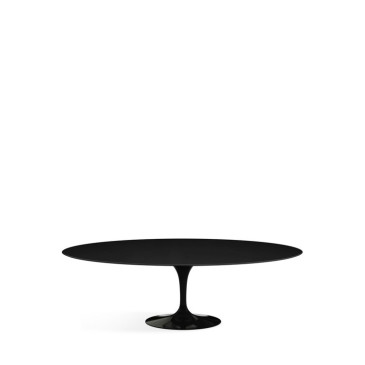

The Tulip collection naturally finds its home in the dining room, where the combination of Saarinen table and chairs produces an immediately recognisable effect. It works equally well in a meeting room, a reception area or an open kitchen where it brings lightness and visual coherence.
At UBER-MODERN, we often suggest combining the Tulip with other pieces from the Knoll catalogue. A marble Tulip table with Bertoia chairs, a round Tulip surrounded by Florence Knoll armchairs: the combinations are many and we are here to help you find yours.